
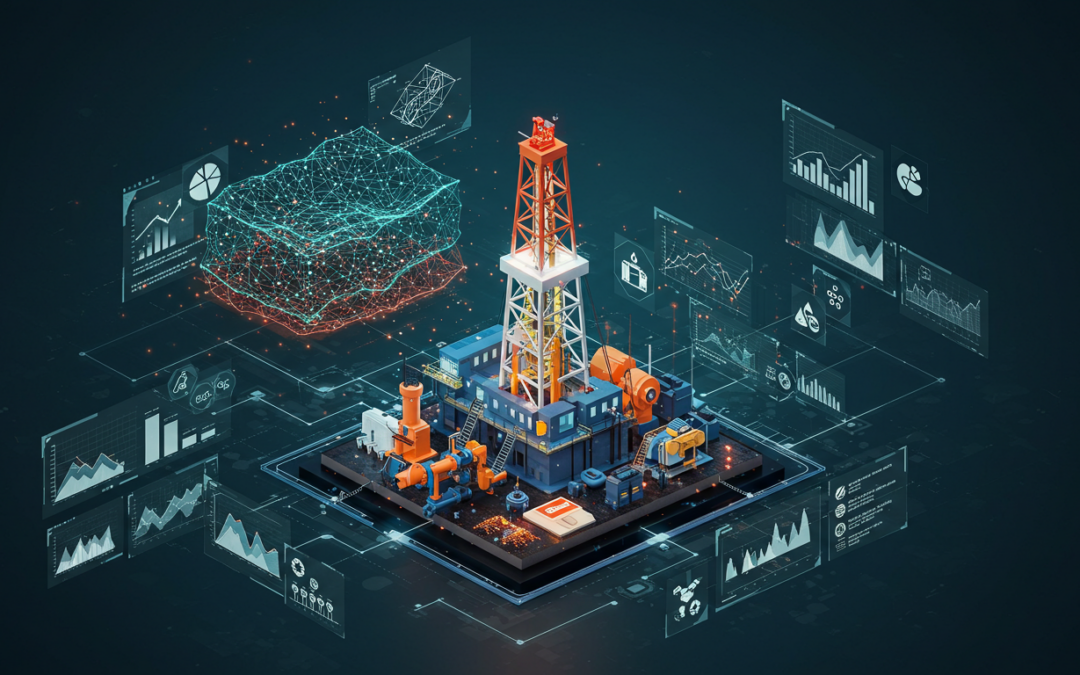
Oil Refineries and AI Tokens
The AI market has moved past the point where model superiority is the decisive variable. The more consequential question is where value is actually being captured, and how fast it is being competed away.
Tokens Are Crude Oil
Models produce raw intelligence. They generate tokens. But tokens are an intermediate good, not a finished product. What customers actually pay for is legal work completed, code shipped, claims processed, research synthesized, and decisions supported.
They pay for refined output.
Attention has focused on the infrastructure layer — the frontier labs, the compute stack, and the data centers. That attention is not misplaced, but it overlooks a structural shift already underway. Once you understand the model as an intermediate good rather than the end product, the center of gravity moves. The decisive question is no longer who can produce intelligence, but who can turn it into something usable, trusted, repeatable, and economically defensible.
In other words, who can refine it into a usable product?
At the base of the chain sit the token producers — OpenAI, Anthropic, Google DeepMind, Meta, DeepSeek, and Qwen. They produce raw capability. This layer is expensive to build, technically formidable, and still moving fast. But crude oil is not gasoline.
Enterprises and consumers pay for gasoline.
The first form of refinement occurs within the labs themselves. ChatGPT, Claude, and Gemini are not model access points — they are products. This distinction matters. The “labs will be immediately commoditized” argument has always been too simple; the strongest labs are not only drilling crude but also capturing downstream markup. That is already a real business, even if it does not yet fully fund the drilling.
It’s the Work
Refinement happens when AI embeds itself in specific workflows, industries, and customer relationships. Harvey is doing this in legal. Others are doing it in defense software, clinical workflows, compliance, finance back offices, and vertical SaaS. This layer takes cheap model output and converts it into something more valuable — through better context, process integration, domain expertise, and distribution.
This is why the industry’s dismissal of “wrappers” has become analytically lazy. There is a wide gulf between a generic chatbot product and a company woven into a regulated workflow with years of institutional context built into its architecture.
AWS built critical first-party products, but the cloud era’s most durable value creators were third-party companies — Datadog, ServiceNow, Workday — that sat atop shared infrastructure and captured premium pricing by focusing on specific domains.
That pattern now maps directly onto the AI stack.
The Spread
The simplest way to evaluate any AI company is to ask one question: how wide is the spread between its token input cost and the value of the output it delivers? In much of today’s knowledge work, service professionals charge based on labor scarcity, credentialing, and process complexity.
AI restructures the cost side of that equation.
If a model can perform meaningful portions of that work at near-zero marginal cost, the competitive battle shifts to who captures the markup between cheap intelligence and high-value delivered outcome.
Three factors determine whether a spread holds or collapses.
Workflow Ownership
When an AI product embeds itself in a complex, vertical-specific, high-consequence workflow, replacement is a high bar to clear. Customers do not simply purchase output — they purchase the reliability that the output appears in the right place and format, is connected to the right systems, and has the right approvals and audit trails.
Once a product becomes part of an enterprise’s operating system, the competitive question changes entirely. It is no longer a question of whether another model is cheaper or smarter. The question is whether the entire workflow can be rewired without incurring prohibitive costs, risks, or disruptions. Usually, it cannot.
Accumulated Context
Clever prompting gets absorbed with remarkable speed — the frontier labs hoover up every technique that surfaces in the market. Real accumulated context includes customer records, prior work, compliance history, integration with adjacent systems, and operational memory.
The more useful a product becomes because it sits inside a growing body of proprietary context, the less interchangeable it becomes.
Anything engineering-related — tooling, prompts, etc. — rarely sustains an advantage for long. Non-engineering advantages — domain expertise, user data, distribution, behavioral habit — prove considerably more durable. The things most easily demonstrated are the things that travel fastest. The things that stay sticky sit quietly in behavior, habit, output, and institutional memory.
Scarce Competition
When fifty startups refine tokens into generic customer support chatbots, the economic value collapses quickly. When a company is among the small number trusted to operate in medicine, national defense, or the regulated financial infrastructure, margin holds — because access is scarce. The opportunity to arbitrage the gap between low token cost and high output value is precisely why so many refineries are gravitating toward high-value sectors first. Where structural scarcity exists — regulatory barriers, security clearances, deep institutional trust — the spread persists.
What is scarce in those environments is not intelligence. It is permission, trust, and workflow access.
An Early Signal
In the US, AI value is captured at the model layer, where frontier labs command capital and premium pricing, and the application layer, where companies build on top of that intelligence.
In China, that picture has already been compressed.
Strong open-weight models are widely available in China, and the economics of access have moved lower faster than most Western observers anticipated. This has not killed the model layer — model quality still matters — but it has shifted the center of gravity downstream. More competition, product differentiation, and monetization pressure now sit at the application and workflow layer.
This is a preview of what happens in any market once model access becomes cheaper and less differentiated. Value is captured through a distinct combination of factors. The analogy is in cooking. The quality of the dish is determined by a combination of factors, including the quality of the ingredients and the Chef’s skills and knowledge in using them.
Unique knowledge combined with quality inputs is the real differentiation.
It’s the Economics
This does not seem to be well understood yet. Too much discourse views AI through a geopolitical or ideological lens rather than through a market-structure lens. Questions about whether open-source adoption is state-led or whether edge deployment is driven by cloud privacy paranoia reveal that framing the problem this way is drifting away from economic reality.
Open-weight AI is cheaper, with workable inputs everywhere: it is effective, reduces costs, and fierce downstream competition forces speed. The drivers are economic.
Three Observations
- Commoditized crude does not kill the refinery business — it can expand it. Lower input costs and lower barriers to entry generate more experimentation, more verticalization, and more attempts to package intelligence into differentiated end uses. Refinery economics becomes more important, not less.
- Winning refineries differentiate themselves in distribution, product, and context — not in raw model intelligence. It is a preview of what happens in any market once “who has the smartest model” becomes less decisive than “who has the most economically useful product.”
- Margins compress. Intense competition narrows the gap between token input cost and final selling price. Winning refineries run leaner, move faster, and iterate with more urgency as a result. If open-source continues closing the global capability gap, more of the AI world will converge toward this structure. The standalone profit pool at the model layer faces real pressure. Once that happens, the central investment question shifts: one stops asking primarily who owns the best model and starts asking where the model is economically indispensable.
The Harder Question
Some assumptions should be examined more closely: whether frontier labs will maintain their lead, whether the market is still early enough for commoditization not to have occurred, and whether U.S. government intervention will slow AI’s capabilities.
In commodity markets, analysts fixate on the marginal producer because it sets the price. Something directly analogous is happening in AI.
The frontier labs may be better positioned because the strongest among them are building first-party products rather than merely selling raw model access. If the leading labs can package intelligence directly into useful, workflow-embedded products, more value flows back to them.
But model advantage matters only up to a point. Beyond that point, value capture is determined by whether a product commands sufficient workflow depth, accumulated context, and distribution. API access alone will not be enough. First-party chat products will not be enough.
Upstream commoditizing while downstream refinement captures value is not unique to AI. It was true in the cloud, mobile, and every major platform transition. In each case, the raw infrastructure became foundational, yet the most durable value accrued to the companies that transformed it into category-defining systems of work. The existence of a powerful platform does not eliminate the need for downstream specialists. It raises the bar for which specialists survive.
In AI, tokens are crude oil. The more enduring question is the one markets have always faced in these transitions: where does the markup live once the raw input gets cheap, and what keeps that markup from being competed away?
Who Wins or Gets Displaced – Drillers Becoming Refiners
OpenAI: Dominant Brand, Precarious Position
OpenAI commands the most recognizable brand in consumer AI and has achieved genuine scale: ChatGPT’s message volume has grown eightfold since late 2024, and the company claims over 35% of U.S. enterprise customers. These are not trivial accomplishments, but OpenAI’s position looks considerably less durable than its headline numbers suggest.
The core problem is structural. OpenAI does not have a unique technology — competitors have broadly matched its model capabilities — and its large user base exhibits shallow engagement with limited network effects. The majority of its revenue still flows from consumer subscriptions, a base increasingly threatened by Google’s Gemini, which arrives bundled with services that hundreds of millions already use.
OpenAI’s enterprise momentum is real, but it faces rivals with deeper product and distribution infrastructure. What OpenAI has is mindshare, first-mover momentum, and the most widely recognized AI product name on the planet.
What it does not yet have is a clear and durable competitive position.
There is also the potential existential crisis. The company has committed $1.4 trillion to infrastructure over the coming years. At that capital intensity, enterprise growth is not optional. Every dollar of infrastructure spending must yield a return. The arithmetic is punishing.
OpenAI is not in danger of disappearing. But at its implied valuation, it must execute a near-perfect transition from mindshare to workflow ownership, and do so against adversaries with structural advantages it cannot easily replicate.
Good luck.
Anthropic: The Enterprise Refinery
Anthropic is a refinery. The company has built its enterprise strategy around deep workflow integration, accumulated institutional context, and access to regulated sectors where competition is structurally scarce.
Roughly 80% of Anthropic’s revenue comes from enterprise subscriptions and API usage. Its safety-first Constitutional AI framework has become a competitive asset as enterprise procurement shifted decisively toward governance and reliability over raw benchmark performance.
Claude Code generating over a billion dollars in revenue within six months is not simply a product success — it is evidence of deep workflow penetration in the highest-leverage category of knowledge work: software development.
However, Anthropic’s cloud infrastructure costs are staggering — the company is committed to paying Amazon, Google, and Microsoft at least $80 billion in compute costs through 2029. That dependency means Anthropic’s cloud partners capture about 30% of its economics regardless of how well the company executes.
The refinery earns the spread; the pipeline owner takes a toll.
Anthropic’s multi-cloud strategy — anchored by Amazon, with material relationships at Google and Microsoft — provides some negotiating leverage and makes it a genuinely neutral option for enterprise customers who do not want to strengthen a direct competitor. But the capital structure imposes a ceiling on profitability, compromising its valuation.
Also, a company that markets itself on safety and controllability cannot afford a catastrophe, as with Claude Code in early 2026. Safety is only durable when it extends all the way to how tools behave under real enterprise conditions.
Whether it can maintain execution discipline at the velocity it is scaling is the open question.
Google: The Vertically Integrated Refinery
Google’s AI position is often underestimated precisely because it is so sprawling. Gemini, as a standalone product, is often cast as ChatGPT’s less-fashionable competitor. That misses reality. Google is not primarily a chatbot company. It is a vertically integrated AI stack — from custom silicon (TPUs that deliver roughly a 40% cost advantage over Nvidia-dependent competitors) to frontier model development to cloud infrastructure at Google Cloud to distribution through Search, Android, Chrome, Gmail, and Workspace.
No other company owns all five layers simultaneously.
Google Cloud is growing at over 30% annually. Its Vertex AI platform provides enterprises with a managed environment for building on Gemini without sending data through Google’s consumer properties. Its relationship with Anthropic — a $3 billion stake and deep integration via Google Cloud — gives it exposure to the fastest-growing enterprise AI franchise while also validating its infrastructure. The TPU cost advantage compounds over time as inference volumes scale rapidly.
However, Google has repeatedly demonstrated the capacity to build breakthrough technology, but has failed to translate it into company-owned success (the latest example is the transformer, the foundation for ChatGPT, which was developed at Google and then given away for free to create formidable competitors). The history of Google products that arrived first and won second is too long.
Google is confronting “the innovator’s dilemma” at full force. AI search integration has proven more disruptive to its own revenue model than expected, creating internal pressure that makes aggressive product moves harder to pursue.
Google needs to convert its technical and infrastructure advantages into sticky workflow ownership — and it must do so at a pace that its organizational culture has historically struggled to sustain.
Microsoft: The Distribution Refinery
Microsoft owns enterprise distribution. Office 365 and Teams sit on hundreds of millions of desktops. Azure is the cloud of record for most large enterprises. Copilot — AI embedded into Word, Excel, Teams, and the entire M365 stack — does not need to win a benchmark competition. It needs only to be the enterprise’s default option when existing workflows need to become AI-augmented.
Microsoft’s investment in OpenAI, now representing a 27% stake with deep Azure integration, gives it first access to frontier model capability. The strategic bet is that Microsoft does not need to win the model race. It needs to ensure that whoever wins the model race does so on Azure infrastructure and pipes those capabilities through Microsoft’s enterprise distribution layer.
This is a refinery strategy disguised as an infrastructure play.
Microsoft captures the spread not primarily by building AI but by owning the enterprise customers.
The vulnerability is execution quality. Copilot’s early reviews from enterprise deployments were mixed — users found it inconsistent, occasionally unreliable, and not yet worth the premium over its price for everyday tasks. If the product does not convert its distribution advantage into genuine workflow ownership — if users treat it as an occasional assistant rather than a system they depend on — Microsoft’s advantage diminishes.
There is also a strategic tension between Microsoft’s relationship with OpenAI and its own internal model development. If OpenAI’s competitive position deteriorates, Microsoft’s access to frontier capability becomes more expensive or less exclusive. The company is managing this risk by diversifying, but it is still dependent.
Amazon: The Infrastructure Refinery
Amazon is not primarily competing to produce the best model or win the most enterprise AI contracts directly. It is building the infrastructure — compute, chips, storage, managed services — on which everyone else’s refineries run.
AWS remains the dominant cloud platform with approximately 30% market share. Its Bedrock service hosts models from Anthropic, Meta, and others, making AWS the neutral ground on which enterprises build AI workflows without committing to any single lab. Its proprietary Trainium2 chips are already training Anthropic’s Claude models, which serve as both a validation of the hardware and an anchor for the relationship.
The Amazon strategy is to own the pipeline, not the crude.
Cloud infrastructure providers like Amazon capture up to 30% of AI startup economics through hosting fees and revenue shares — structural toll collection that compounds as the AI economy scales, regardless of which model or application layer ultimately wins. This is a durable position precisely because it does not depend on picking a winner. It depends only on the infrastructure.
The vulnerability is the same as AWS: the biggest customers eventually build their own. Large enterprises with sufficient scale are already developing in-house model infrastructure and negotiating aggressively on hosting costs. The lead that AWS holds in enterprise trust, ecosystem breadth, and tooling depth is real but not permanent.
Google Cloud and Azure are growing faster. Amazon’s AI infrastructure bet must continue generating sufficient value to justify the $200 billion in capital expenditure it has committed for 2026 alone.
That is a high bar.
Meta: The Open-Source Wildcard
Meta is a paradox. No other major player has made a more deliberate bet on commoditizing the very layer that its competitors are trying to monetize. By releasing Llama as an open-weight model, Meta has systematically undercut the pricing power of every proprietary lab.
This was not altruism. It was a calculated move to become the Android of the LLM era: set the standard, seed the ecosystem, and then capture value through the layers above and below.
Meta’s core business — advertising across Facebook, Instagram, and WhatsApp — does not depend on charging for access to AI. It depends on AI making its platforms more engaging, its ad targeting more precise, and its content moderation more effective. If Llama becomes the default open-weight foundation that thousands of developers build on, Meta gains an ecosystem without needing to extract API revenue from it.
The advertising flywheel funds the compute; the open-weight release builds the developer base; the developer base accelerates capability improvements through external fine-tuning and research contributions that Meta then absorbs back into the next generation of models. It is a refinery strategy in which the product being refined is not an external output but Meta’s own core business infrastructure.
Meta’s compute position reinforces this. With over 1.5 million GPUs by early 2026, a $115 billion capital expenditure plan, and a nuclear energy partnership to power its data centers, Meta is not treating AI as a side initiative. The Llama 4 family — Scout with a ten-million-token context window, Maverick as a multimodal workhorse, and the Behemoth research preview at two trillion parameters — represents a serious bid for technical leadership in the open-weight category.
The government channel adds a further dimension: Llama’s availability to U.S. defense agencies and contractors, via partners such as Palantir, Lockheed Martin, and Anduril, gives Meta a sovereign AI footprint that proprietary, closed-source models cannot easily replicate.
The open-source strategy works only as long as Meta remains the undisputed frontier leader in the open-weight category. The moment a rival open-weight model surpasses Llama — which DeepSeek demonstrated is possible, building directly on Meta’s released weights — the strategy inverts. Meta becomes a free R&D subsidy for competitors rather than the ecosystem anchor. The reported failure of the Llama 4 Behemoth training run, combined with benchmark controversy and the departure of Yann LeCun amid accusations of fudged results, exposed exactly this fragility. If Llama falls to second place in the open-weight category, the developer ecosystem migrates to the superior alternative, and Meta’s strategic architecture collapses.
Meta builds the crude and then gives it away. It captures value through advertising, not through the kind of workflow embedding, accumulated context, and institutional trust that defines durable spread protection. When AI agents begin optimizing against Meta’s own advertising inventory, the same forces that Meta has weaponized against the proprietary labs will turn inward. Meta’s refinery thesis depends on advertising economics remaining robust even as AI commoditizes everything around it. That is a durable bet for now. Whether it holds as autonomous agents increasingly mediate the relationship between consumers and commercial content is the question Meta has not yet fully answered.
The Synthesis
Revenue is growing because AI expands the surface area of work. Valuations are falling because the marginal economics of that work are shifting. The old pricing models — per seat, per license, per user — were calibrated to a world of human-operated workflows. The new pricing models will be calibrated to a world of agent-operated outcomes. The transition period between these two worlds is where the greatest valuation compression occurs, and where the greatest opportunities to rebuild defensible positions emerge.
For the frontier labs, the key variable is whether model advantage converts into workflow ownership before the model advantage itself compresses.
- OpenAI faces this urgency most acutely.
- Anthropic is furthest along in executing it.
- Google has the structural assets but must overcome organizational execution risk.
- Microsoft has the distribution advantage but must prove its products achieve genuine workflow embedding rather than convenient peripheral adoption.
- Amazon is the most structurally insulated — owning the pipeline rather than the crude — but faces the long-run risk that its largest customers build their own.
- Meta’s open-source strategy deliberately commoditizes the crude, betting that advertising economics will capture value that proprietary labs are trying to capture. This holds as long as Meta remains the open-weight leader and as long as AI does not ultimately disintermediate the advertising markets it depends on — neither of which is guaranteed.
The broader lesson from the refinery thesis is that disruptions and technology transitions rarely destroy all the value incumbents have built. It destroys the value captured through interface and process complexity — the parts that AI agents can replicate cheaply.
It preserves and often amplifies the value that was captured through data accumulation, institutional trust, and workflow depth. The companies that survive the current transition, at every layer of the stack, will be the ones that correctly identify which category their core assets fall into — and act accordingly before the window closes.
In AI, tokens are the crude oil. The markup lives in the refinery. The question, for every company in this analysis, is the same: what exactly are you refining, and is that refinery defensible once the crude gets cheap?